December 8, 2011

Civil Disobedience

Civil Disobedience
Henry David Thoreau
pages 715-727

The general argument that is made by Henry David Thoreau in his work Civil Disobedience is that when the government is corrupt or unjust, the people under its rule have no obligation to follow it. More specifically, he argues that the United States' government is corrupt and he felt no obligation to be associated with it. He writes, "I think that we should be men first and subjects afterward. It is not so desirable to cultivate a respect for the law, so much as for the right." (page 723) Here, he is stating that it is more important to be a man under one's own beliefs and making judgments based on those rather than being a subject, forced to make judgment based on the beliefs of their ruler. In conclusion, it is Thoreau's belief that the people under a government have the right to disassociate themselves from it and to abandon its structure if they see it to be unjust or wrong.

In my view, Thoreau is right because I believe that the government, especially in Thoreau's time, takes advantage of power and looks past the needs of its people under it in order to get the most power and control of the region it rules. For example, people are currently protesting the government and large businesses in the way that officials of each are paid. These protestors are showing their disagreement and somewhat disobedience to the people of the government and these businesses. Although people who disagree with Thoreau may object that governments can practice their power in these ways becasue of how large they are, I maintain that he is correct in arguing that people should not have to live under the reign of a corrupt and unjust government. Therefore, I conclude that people should be allowed to exercise the right to ignore a government's laws if they believe that it is being unjust. I think that people should be allowed to do this through protests or boycotts but that violence and other aggressive approaches would make them just as bad as the government.

Civil Disobedience Questions File


November 14, 2011

Langston Hughes Poems

Langston Hughes Poems
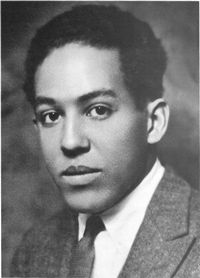
Langston Hughes
pages 593-594

The general argument made by Langston Hughes in his poem “I Too” is the suffering America experienced from racial inequality between whites and blacks. More specifically, Hughes argues that America is wrong in the way blacks were dismissed. He writes, “They send me to eat in the kitchen when company comes.” (page 594) Here, Hughes is describing the way that the American “family” dismisses the “darker brother” to the kitchen for dinner as though they are ashamed and embarrassed by him. He continues to write, however, “Tomorrow, I’ll be at the table.” (page 594) Here he is describing the hope he feels for blacks and whites to be considered equals. In conclusion, it is Hughes’ belief that blacks were treated unfairly under the discretion of whites in America.

In my view, Hughes is right because I agree that in the time period he wrote the poem, America treated blacks very unfairly and that whites were wrong in their opinion that they were in any way superior. For example, there were many laws back then that made white people’s lives easier than blacks and racism was tolerated too much. Although Hughes may argue that the people then did not fully understand the equality of men, it is my position that blacks were treated too poorly. Therefore, I conclude that Hughes’ position on racism in the early 1900’s of America was right.

October 24, 2011

Favorite Poem Project: Passion and Romance

In Former Days
Bhartrhari
page 296

In former days we'd both agree
That you were me, and I was you.
What has now happened to us two,
That you are you, and I am me?

Author: Bhartrhari was a poet and philosopher in the 5th century. Through his life, he struggled to live the ascetic Hindu lifestyle, influenced by luxury and women. However, near the end of his life, he became a yogi and began living in a cave, leaving behind all the worldly things that had kept him down.

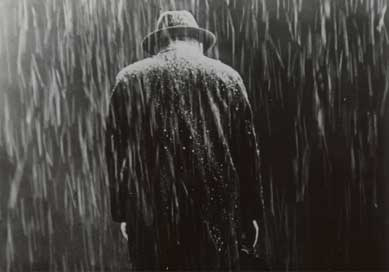
Response: This poem stuck out to me, not only because it was short, but also because I really related to it for some reason. When I first read this poem, I pictured somebody reflecting on their past and all of the changes that they had made through their life. I thought this before I read about Bhartrhari and his change but liked the poem even more after learning of his life. I chose the image the man in the rain with his back towards the viewer because it reminded me of what people might often think when they reflect on changes they've made in their life, leaving things behind. I can relate to changing things in my life such as remembering what it was like being a kid, growing up and making new friends while leaving others, and other things. This is now one of my favorite poems because I think that anyone who reads it can relate to this and I think everyone has had to make some kind of change and reflection like Bhartrhari's in their life.

Art of Courtly Love

Art of Courtly Love
Andreas Capellanus
pages 299-302

Summary: In these pages, Capellanus gives readers a detailed examination of courtly love. This love originated in Southern France. These types of relationships are modeled by the relationships that a knight and a lord would have. They are the basis for chivalry.
Argument/Main Idea: The main idea of this selection is basically what love is and how it works, where it comes from, and what it means in relating intimately to another person. It is almost a list of instructions and rules that should be followed in order to love "properly."
Evidence:
"Too great an abundance of passion impedes love..." (page 300) Too often, people see love as a complex sort of thing and concentrate on pieces of love, like passion and romance, instead of the simple act of love itself.
"4. Love is always growing or diminishing." (page 301) Love is always there. Sometimes it's large and sometimes it's small. No matter what, though, it is always there in a big or small form.
Response: I liked Capellanus' "Rules of Love." A lot of these rules seemed like they are pretty much what the society we live in applies to love today. Rules like "Marriage is no excuse not to love" and "A man cannot love until he has fully reached puberty" are still very prevalent in our views on love nowadays.

October 22, 2011

Tristan

from Tristan
Gottfried von Strassburg
pages 302-305

Summary: Gottfried von Strassburg's poem Tristan is about two young people who accidentally drink a love potion and enter love's unbreakable spell. Tristan and Isolde can then not be separated from one another and do whatever it takes for them to stay together.
Argument/Main Idea: People, especially those who are young and inexperienced in life, will do anything for love and cannot escape its powerful grasp. Tristan and Isolde are two young people stuck in an inseparable case of love.
Evidence:
"Love, the reconciler, had purged their hearts of enmity, and so joined them in affection that each was to the other as limpid as a mirror. They shared a single heart. her anguish was his pain: his pain, her anguish." (page 303) After, drinking the love potion, Tristan and Isolde are inseparable.
"These two seemed fairer than before-- as is Love's law, such is the way with affection." (page 304) Each time the two set eyes upon each other, they love the other more. That is the way that love works, getting stronger with every connection.
Response: I think that through writing about the relationship between Tristan and Isolde, Strassburg was expressing his own feelings towards love. Love is unbreakable and is the strongest connection that two beings can share between one another.


Passion and Romance- Introduction Pages

Introduction to Passion and Romance
pages 279-280

Love is the strongest of man's emotions. It can never just be referred to as "love" but always has to be compared to something in or to show just how strong and powerful of a thing it is. It "must always be 'like' something, must always be a metaphor, a 'red, red rose,' or the embodiment of sun or the stars."

Nature Issues Responses

Out of all the nature issues that have been presented in class so far, the two that had sides that made me think the most were Tim and Api's on whaling and Marisa and McKenzie's on solar energy. After seeing their presentations, I was persuaded to be for both of these issues.

Many people would disagree when it comes to being for whaling but the way it was presented made me think it was beneficial. For many cultures, whaling is done as a tradition and the whales are used as a significant resource. People depend on the whales for food and other uses. One other thing that helped persuade me to be for whaling was learning that the way it is done, whales do not suffer when they are killed.


I was persuaded to be for solar energy because it is an easy and fast way to get energy while avoiding using temporary resources. Also, the fact that it was a personal energy source, meaning that it is an easier source to power a personal residence or business with, was another point that persuaded me because being able to gather your own energy sounds better than having to rely on a company that provides to thousands of people at once.


October 21, 2011

A Fable for Tomorrow

A Fable for Tomorrow
from Silent Spring
Rachel Carson
pages 370-371


Summary: In this passage, Carson describes a town in America where everything that could possible gone wrong has. She describes how all the birds are gone, farmers can't raise pigs, roadsides are littered, and other problems. At the end, she says that this town really doesn't exist but that other towns really have experienced at least one of the things she described.
Argument/Main Idea: I think that the argument Carson was trying to make was that if America doesn't step it up, per se, then it could inevitably end up like the town she earlier described.
Evidence:
"A grim specter has crept upon us almost unnoticed, and this imagined tragedy may easily become a stark reality we shall all know" (page 371)
Response: I think that Carson had a very strong view as to what lays in America's future though she may have expressed it somewhat calm and almost subliminal. If things don't change, her reference the the stark reality surely could happen.

Polemic: Industrial Tourism and the National Parks

Polemic: Industrial Tourism and the National Parks
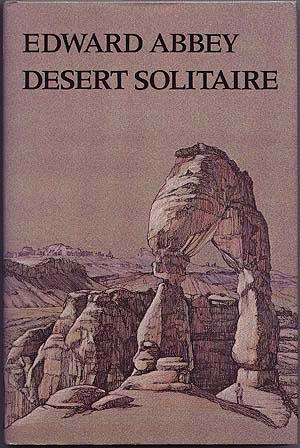
from Desert Solitaire
Edward Abbey
pages 385-390


Summary: The Polemic written by Edward Abbey expresses his view point on the National Parks system in America. He feels that the parks are catering to tourists and their wants more than they are focusing on what they should really stand for, the nature to be observed. He thinks that parks should be kept as natural as they can and that people should have to cater to the parks rather than vice versa.
Argument/Main Idea: National parks should be preserved and kept the way they are rather than altered and destroyed by human developments to make it easier for people. Abbey believed that humans were ignoring nature, putting their own wants in front of the Earth's needs. He believed that if people wanted to enjoy natural beauty, they should enjoy it the way nature presents it rather than alter things to make it easier for themselves.
Evidence:
"It is the primary responsibility of the National Park system to preserve intact and undiminished what little still remains." (page 387)
"... that their primary duty is to serve the public, not preserve the wilds ..." (page 388) Here, Abbey is expressing what he feels National Park rangers duties now entail. Their duty seems to be to please to people, the visitors of the park, rather than to please the park itself.
"I now feel entitled to make some constructive, practical, sensible proposals for the salvation of both parks and people." (page 389-390) After this statement, Abbey proposes a list of rules he feels the National Parks should instate in order to preserve them while also serving the visitors coming to see them.
"If we could learn to love space as deeply as we are now obsessed with time, we might discover a new meaning in the phrase live like men." (page 390)
Response: I think that while Abbey comes across somewhat extreme, he still has a strong and valid point when it comes to man's responsibility to preserving the land. As humans, we need to leave behind our greedy desires to have things handed to us and accept that we must sometimes actually work for what we want. As crazy as it sounds, it needs to be done.

Sketch of a Visual Artist


The sketch of a visual artist assignment was fun because it was yet another chance to engage in something we enjoyed while learning about the humanities at the same time. Everybody got to choose a different artist and present it to the class. This gave us the opportunity to share both what we like and have a personal connection to and also to share what we've learned when it comes to interpreting others' expression through art. I chose Shepard Fairey for my sketch because he has been a favorite artist of mine for a long time and I consider myself an artist following in his footsteps through shared opinions and techniques.


Sketch of a Visual Artist File

Burrowing Owls

Burrowing Owls
from Refuge
Terry Tempest Williams
pages 414-417

Summary: This is an excerpt from the book Refuge by Terry Tempest Williams. Williams is a Utahn and a naturalists. Many of her works, including Refuge, deal with the relationship between humans and nature and what needs to be done to preserve our beautiful earth. "Burrowing Owls" is about Williams' encounter with burrowing owls that live near the Great Salt Lake. It is her personal account on what was done to their land and what humans need to do to respect animals and nature.
Argument/Main Idea: Man has a responsibility to nature that is to live in tune with what it presents to them. Williams feels a need towards burrowing owls that she has a responsibility towards them. "There are those birds you gauge your life by. The burrowing owls ... are mine." (page 415)
Evidence:
"My interest lay at 4.206' the level which, according to my topical map, meant the flooding of the Bear River Migratory Bird Refuge" (page 415) All that Williams is concerned about is the birds and the flooding and how she can save them from it.
"Many men have forgotten what the are connected to ... Subjugation of women and nature may be a loss of intimacy within themselves." (page 416) Williams believes that men are the reason nature is depleting among itself because they have forgotten what they owe to it after all that it has offered and done for them.
Response: I agree with Williams that mankind is what is causing the problems within nature. Granted, we can't surrender our own wellbeing and success for that of trees and owls, but we can do everything in our power to help. If everyone would focus on a little more than just themselves, then I think the world would generally be a better place for both humankind and nature alike.


Nature- Introduction Pages

Introduction to Nature
pages 341-343

"Nature" or "natural" have many different meanings and can be interpreted countless ways depending on what is being seen and who it is being seen by firsthand. Nature to me is any unaltered beauty of the world.
Cultures around the world see nature differently which creates different local and cultural interpretations of "nature" and how it pertains to their immediate surroundings. Some people worship nature, others rely on it for survival. It depends on where they live.
Today, nature has taken the role of what could be considered a victim of humankind's selfish greed. Mankind, now more than ever, has a great impact on nature. The two must coexist with another in order for each to survive.


Visual Cultural Activity


I really enjoyed the visual cultural activity because it gave us a chance to take what we've learned in class about interpreting things and expressing how we feel while looking at a piece of somebody else's work. I enjoyed being able to apply the my new knowledge of how to look at something and look beyond the visuals of it but to also be able to look into it and think about what the artist was trying to say through the particular work of art.

Visual Cultural Activity File

Sacred Texts: Buddhism

My three questions when starting my assigned reading on Buddhism were:
Q. How is the new Dalai Lama chosen?
A. The new Dalai Lama is chosen based initially on looks. If a young boy looks like the Dalai Lama, they will then present items that belonged to the previous Dalai Lama and if the boy chooses the right ones, then Buddhists believe that this means he is the Dalai Lama reincarnated and he becomes the Dalai Lama again.
Q. What kind of "scripture" do Buddhists believe in?
Buddhists believe in a sacred text called the Tipitaka which they follow as teachings.
Q. What do Buddhists believe when it comes to life after death?
After death, Buddhists believe that you are reincarnated and eventually after having lived a virtuous life, you will reach Nirvana.

I found the answers to all three of these when I was helping my group write our presentation on the religion of Buddhism.

Buddhism Presentation File

October 20, 2011

Creation Myth

The creation myth activity has been my favorite section of this class so far. I enjoyed this because it was an opportunity that we had to be able to express our imaginations and be able to share something with the class that we each came up with on our own.


Creation Myth File

Reading and Interpretation Exercises

So far, I've learned that humanities is basically learning more about humankind through your own opinions and observations. I want to learn more about different cultures and worldwide traditions and beliefs and what life is like for people who have never had opportunities that we get to experience in our western culture. To succeed in class, I think I will need to practice self discipline to get my work done and done well.

Reading and Interpretation Exercises File

Shakespeare in the Bush


"Shakespeare in the Bush"
Laura Bohannan
pages 29-35

Summary: This article was written by Laura Bohannan after she went on a visit to the African Bush. She wrote the article after she had an experience in the bush trying to read the natives there the story of Hamlet written by William Shakespeare.
Argument/Main Idea: Though cultures have many different customs and beliefs throughout the world, mankind can se many similarities in interpreting and understanding between each other no matter where they come from as long as explanation and discussion can take place.
Evidence:
"'you must explain what we do not understand, as we do when we tell you our stories' Realizing that here was my chance to prove Hamlet was universally intelligible." (page 30). Bohannan sees that she has the opportunity to convey her argument after the tribe leaders ask her to explain her story as she goes, just as they do for her.
"We who are elders will instruct you of their true meaning, so that when you return to your own land, your elders will see that you have not been sitting in the bush, but among those who know things and who have taught you wisdom." (page 34). The Tiv leaders, after hearing the story of Hamlet, believe that they are really the ones who have taught the lesson. As the story was told, they corrected and informed Bohannan the true meanings of the story that she was sharing.


Visual Depiction of ME

This is a picture of me!
Mac-Miller-Best-Day-Ever-Mixtape-Cover-540x540-470x470.pngarnold-palmer-half-and-half.jpgMy favorite musical artist is Mac Miller and my favorite drink is Arnold Palmer iced tea lemonades.1308916822-44.jpgI love to golf!golden-gate-bridge-picture.jpgSan Francisco is my favorite place that I've ever visited.adobe-cs3-icon.jpgI want to be a graphic designer, these are all the Adobe CS3 program icons.

Top Themes and Big Question

Top 2 Themes: Freedom & Responsibility and War

Big Question: Why are wars fought?
I think that wars are fought to satisfy the constant hunger for power that lies in mankind. I think that it is within human nature to rule something and have power over others and that this is why wars are fought. I also think that wars are often fought to protect rights that many believe are given through birth, the natural rights of man.

freedom.jpg

What is Humanities?

Humanities, to me, is anything and everything to do with humans and human life. It is the way people think, act, and overall live their lives while being influenced by their local cultures, beliefs, and traditions.

Humanities.JPG.jpg