In Response to Executive Order No. 9066:
All Americans of Japanese Descent Must Report to Relocation Centers
Dwight Okita
page 743
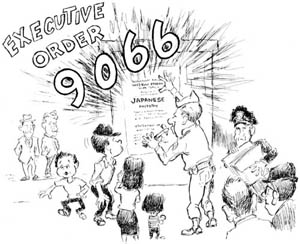
The general argument made by Dwight Okita in his work In Response to Executive Order 9066 is that too many Americans were treated unfairly by the actions of the Japanese on Pearl Harbor. More specifically, he argues that it was wrong for all the Japanese-Americans to have to relocate to the internment camps. He writes, "If it helps any, I will tell you I have always felt funny using chopsticks and my favorite food is hot dogs" (page 743) In this passage, he is showing just how American these people really were. He also says "She was sitting on the other side of the room. 'You're trying to start a war,' she said, 'giving secrets away to the Enemy, Why can't you keep your big mouth shut?' I didn't know what to say." (page 743) Here, he shows the harsh and irrational conclusions that many other Americans made about people with Japanese descent and how they were unfair. Further more, Okita is suggesting that it was unfair and wrong of all those innocent people to lose so much of their lives, if they lived through the internment camps, and that the government and other citizens of the United States were in the wrong.
In my opinion, I think that Okita is partially correct in what he was saying, it was wrong of these people to be forced out of their homes and to leave to such unpleasant places. However, you have to look at the otherside. For example, the government didn't know who the Japanese spies in the country were so they had to make a generalization to prevent further attacks. Also, the camps were somewhat for the Japanese-American's own safety. If they had stayed in their own homes, I think that far further violent and horrible things could have happened to them from unhappy and racist Americans going for the innocent in response of the guilty's actions. In conclusion, I agree that it was wrong for these people to be forced to be put in the camps but that the government can't also be blamed and held fully accountable for the action.
